In this article…
Field Guide: Rig Logistics, Launch Preparations, and Wilderness Trails at Lake Louisa State Park

Lake Louisa State Park is located just south of Clermont, Florida, on the outer edge of the pristine Green Swamp wilderness. Lake Louisa State Park stands as a serene refuge of rolling sandhills, six distinct lakes, and eleven highly specialized plant communities. While many travelers view it as a quiet alternative to the chaotic theme park corridors of nearby Orlando, for us, it served a far greater structural purpose: it was our final staging ground before officially launching a five-year journey on the open road. Read about how our travel saga began in Our Journey Together Begins.
Rig Clearance, Loops, and Launch Staging

The main approach roads sweeping into tLake Louisa State Park from US Highway 27 are paved and wide, offering a gentle topographic roll that accommodates large towing setups with minimal pitch. We secured a campsite loop for the final two weeks of September 2019, completely transforming our site into a tactical logistics hub. We spent those crucial two weeks packing our entire lives into local storage facilities and systematically emptying out our nearby rental home to meet our official October 1 departure deadline.

The main family campground at Lake Louisa State Park features 60 campsites tucked neatly between Dixie and Hammond lakes. These parking pads are primarily paved asphalt, exceptionally well-leveled, and engineered to comfortably accommodate large-scale towing configurations up to 50 feet in length. The loop design provides a generous turning radius for extended tow vehicles, though some backing paths demand a clean, wide arc to ensure your rear bumper safely clears the decorative roadside boundaries.
The Reality of Partial-Hookup Logistics
While the park infrastructure at Lake Louisa State Park delivers stable 30-amp and 50-amp electrical configurations alongside steady central water pressure, our loop lacked direct sewer hookups during our stay. This partial-utility layout creates distinct holding tank bottlenecks that full-timers must strategically navigate:

- The Initial Staging Period: In our first few days on-site, we actively attempted to preserve our internal capacity by using the public park bathhouses. However, fully transitioning into our internal rig lifestyle eventually became a necessity.
- Dump Station Practice: Operating without a direct sewer connection meant hooking up the entire configuration and towing the rig to the central park dump station every couple of days. While logistically repetitive during a stressful packing window, repeating this loop in a low-stakes environment built bulletproof muscle memory for hitching, weight distribution, and backing angles right at the dawn of our journey.
PRO ROAD TIP: TREAT INFRASTRUCTURE LIMITS AS TRAINING
If you are transitioning to full-time travel, do not view a partial-hookup state park as an inconvenience. Use the structural constraints to master your rig. Forcing yourself to break down camp and navigate to a central dump station every few days turns routine maintenance into fluid, automatic muscle memory.
Family Basecamp: The Ridge Cabins
For travelers hosting visiting family or organizing a formal send-off event during their launch phase, Lake Louisa State Park offers pristine structural lodging completely independent of the dense camping loops. Right before our October 1 departure, my parents came out to join our staging window, securing one of Lake Louisa’s 20 luxury rental cabins.

Built on separate, elevated ridges overlooking beautiful Dixie Lake, these two-bedroom, two-bathroom cabins are fully air-conditioned and come equipped with full kitchens, central heating, linens, and dishes. The true highlight for family gatherings is the massive, fully covered deck layout. These spacious outdoor areas provided a comfortable, quiet sanctuary for our family to share meals and reflect together while we prepped the rig for long-distance cross-country transit.
Lake Louisa State PARK AT-A-GLANCE: OPERATIONAL LOGISTICS
- Hours of Operation: Open from 8 a.m. until sunset, 365 days a year
- Daily Park Entrance: $5 per vehicle (2–8 people); $4 single-occupant; $2 pedestrians/cyclists
- Standard Campsites: $24 per night (plus taxes and a mandatory $7 nightly utility fee)
- Luxury Cabins: $120 per night (plus applicable taxes)
- The Camper Canteen: An on-site shop providing essential firewood, snacks, and bike/kayak rentals
Tannic Shorelines and Water Activities
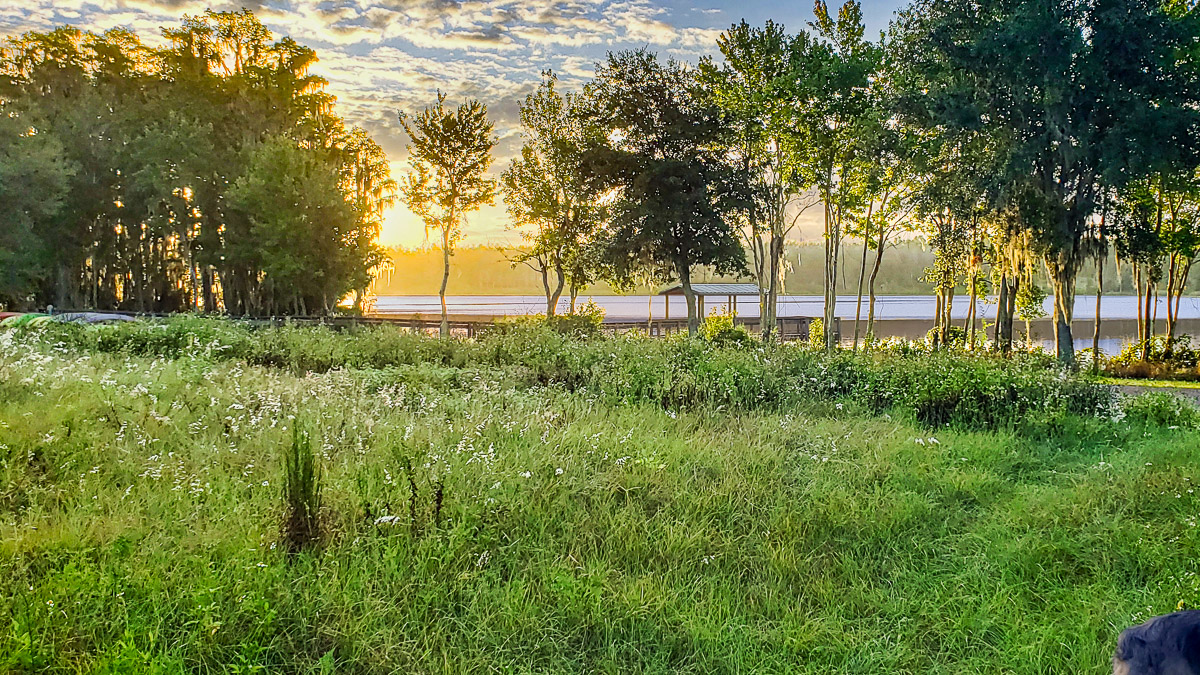
Water defines the landscape at Lake Louisa State Park, and the park offers direct access points across Dixie Lake, Hammond Lake, and Lake Louisa itself. You can launch canoes or kayaks seamlessly into all three bodies of water, with dedicated fishing piers built out over both Dixie and Hammond lakes for convenient shore casting.

For swimmers, Lake Louisa State Park holds the distinct title of being the only body of water in the entire park with a designated beach and swimming area. The water here is heavily tannic—glowing with a deep, dark orange-red hue caused by organic compounds leaching from fallen cypress tree leaves. While visually striking and distinct, the water is entirely clean, natural, and completely safe for swimming.

Paved Corridors and Multi-Use Trails
Beyond the immediate shoreline, the park encompasses over 4,300 acres of protected terrain gridwork. Exploring the sandhills requires moving through 7 miles of paved interior roads and over 20 miles of unpaved, multi-use paths. If you are stepping away from the campsite to stretch your legs, prioritize these four popular trail systems:
Dixie Lake South Trail Loop (6.0 Miles)
An easy, expansive loop that traces scenic lakeside vistas and winds deeply through flatwood paths. Because massive stretches of this trail are entirely exposed to the elements, proper sun protection and extra water storage are mandatory before setting out.
Sandhill Loop and Dixie Lake Trail (2.7 Miles)
A highly popular, family-friendly multi-use loop. The wide corridor is actively shared by hikers, mountain bikers, and horseback riders exploring the open rolling terrain.
Hammond Lake South Loop Trail (2.8 Miles)

Beginning immediately near the main family campground loop, this path is physically distinct for taking travelers directly over the region’s rare, ancient rolling sand dunes and short, sudden hills.
Lake Louisa Blue Trail (1.4 Miles)
A shorter, highly accessible path that winds beneath dense, shaded hammocks. It features several beautiful, quiet lakeside overlooks that are perfect for macro trail photography.
Turpentine, Orange Groves, and Submerged History
Long before the terrain was formally dedicated as a protected state park in 1977, Lake Louisa State Park bore witness to a rich tapestry of local history. It served as a home to ancient Native American cultures, morphed into a bustling center for early 20th-century turpentine operations and lumber sawmills, and eventually became home to massive, sweeping orange groves in the 1940s.

Lake Louisa State Park’s history even holds a fascinating military chapter. During a period of severe regional drought in 2001, the receding, tannic water levels of Lake Louisa briefly dropped low enough to reveal the submerged, preserved wreckage of a 1944 P-51 Mustang military fighter plane that had crashed into the water during a mid-century training mission.

Echoes on the River: Stepping Into Poston’s Desert History
Next week we return to part five of my six-part series about our winter at Echo Lodge on the Colorado River and our visit to Poston, Arizona. Wintering at Echo Lodge Resort offered us a front-row seat to the vibrant, sun-drenched life along the Colorado River Strip, but just twelve miles south of Parker, the desert landscape takes on a vastly different emotional weight.
Driving south into the Colorado River Indian Tribes reservation lands brings you to the historic grounds of the Poston War Relocation Center. As the largest Japanese-American incarceration site in the United States during World War II, this “reservation within a reservation” held over 17,000 people across three distinct desert camps—starkly nicknamed Roasten, Toasten, and Dustin by those forced to endure the blistering elements.